

The topic of Artificial Intelligence (AI) seems to be plastered all over the news these days. Here are a few headlines that have appeared so far this month:
- LinkedIn – The Monopoly Cracks: ChatGPT Loses Its Majority
- BBC World News – AI leaders and G7 leaders lunch and discuss US ‘weaponization’ of AI
- Reuters: Trump tells Axios he no longer views Anthropic as national security threat
- Bloomberg: CEO Andy Jassey is rewriting Amazon’s playbook for the AI Age
How AI is Changing the Job Market
Here are a few that showed up when I highlighted how AI applies to the job market:
- CNN – AI is sparking a job boom – just not for newbies
- Fortune – AI is going to create a labor shortage: Jeff Bezos sees more jobs being created in the new economy, not less
- CNBC – AI is now the leading reason companies give for cutting jobs – what that means for workers
- Yahoo Finance – AI has cut more jobs in 2026 than in all of 2025 already
Ok, welcome back for those of you who scurried away to read those articles. 🙂 In scanning for a few articles I found a HUGE variance in perspectives about how AI is impacting our society, and specifically our American job market. I wouldn’t classify any of it as disinformation or “the world’s going to end” type of hysteria, but I would definitely classify sifting through it as disconcerting and easily causing anxiety about what the outcome could turn out to be.
If you’re unemployed or unfulfilled, I believe it’s a fair opinion that you should be concerned about how AI will affect your prospects of finding the next job that can provide you meaningful work. Whether we like it or not, AI is here to stay.
How Should We Respond to AI in the Workplace?
I’m hopeful to offer some grounding principles that might be useful as you maneuver through job transition or contemplate a future job change. And of course, I utilized AI by posing this question:
“What are first principles we should incorporate with AI as it pertains to the labor market for the future?”
Here’s what AI gave me as a summary:
To successfully navigate the future of the labor market, we must shift away from viewing AI strictly as a tool for automation and cost-cutting. Instead, organizations and policymakers must adopt first principles that center on human augmentation, skills-first mobility, ethical transparency, and worker empowerment. The fundamental principles we should incorporate into the AI-driven labor market include:
1. Human Augmentation Over Automation
- The Principle: AI should be designed and utilized to complement and enable human workers, rather than simply replace them.
- Labor Reality: Instead of hollow cost-cutting, organizations should invest in using AI to eliminate routine tasks, allowing humans to focus on complex problem-solving, empathy, and strategic judgment. Research shows that workers who use AI to learn new skills experience employment growth.
2. A “Skills-First” Talent Infrastructure
- The Principle: The labor market must decouple capability from rigid, historical credentials (like formal degrees) by leveraging AI’s capacity for skill-matching.
- Labor Reality: By mapping skills taxonomies, AI can identify adjacent skills and emerging opportunities, allowing workers to easily pivot and navigate career transitions instead of facing displacement.
3. Worker Empowerment and Institutionalized Voice
- The Principle: Workers and their representatives should be actively involved in the design, testing, and deployment of AI systems in their own workplaces.
- Labor Reality: The people who know the work best should have a seat at the table to ensure technological change makes work safer and more rewarding.
4. Meaningful Human Oversight and Accountability
- The Principle: There must be transparent governance, clear human oversight, and avenues for appeal in any significant employment or disciplinary decisions driven by AI.
- Labor Reality: Workers deserve to know when AI is utilized, how it impacts them, and how their data is collected and used.
5. Lifelong Upskilling and Transition Support
- The Principle: Technological disruption requires massive, worker-centered workforce development systems.
- Labor Reality: Because highly exposed roles (particularly for early-career individuals) can be volatile, employers and educational institutions must provide structured, continuous AI training and transition support.
Ok, maybe if you’re like me, you might be thinking, “Blah, blah, blah, blah, blah.” The “should have’s or should do’s” might make sense from a macro perspective for employers to incorporate, but what do you do as an individual job or purpose seeker?
The Human Skills AI Cannot Replace
I ran across another article from Workplace Intelligence (6/15/26) entitled, “The Human Premium: Why Trust, Empathy, and Relationships May Become the Most Valuable Skills in the AI Economy.” I found this perspective to be much more helpful. Here are a few excerpts:
- If technology can increasingly replicate technical capabilities, what remains uniquely human?
- In a world where information becomes abundant and automation becomes widespread, distinctly human capabilities may emerge as the ultimate competitive advantage.
- The future of work may belong not only to those who know how to use AI, but to those who excel at the things AI cannot truly replicate.
- Trust cannot be downloaded. Meaningful relationships cannot be generated through prompts. Emotional bonds are built over time through consistency, shared experiences, and human interaction. In many ways, the more digital our world becomes, the more people may crave authentic connection.
- AI can provide answers, but it cannot determine which values should guide those answers. It can analyze probabilities, but it cannot define purpose. It can suggest options, but it cannot fully understand human priorities and emotions. As a result, judgment may become one of the most valuable capabilities in organizations.
- AI can assist leaders with analysis and productivity, but it cannot replace the human qualities that inspire commitment and loyalty.
- Technology can amplify human potential, but it cannot replace humanity itself.
The article concludes with this statement: “The greatest competitive advantage may not be artificial intelligence. It may be authentic intelligence – the ability to connect, understand, trust, and lead other human beings.”
I completely agree. Like every other technological advancement in human history, people provide a uniquely human perspective that cannot be fully replicated. We must adapt, flex, and adjust to the ever-changing marketplace, but the fundamentals of critical thinking and sound people skills don’t change. In fact, they become even more important.
How to Thrive in an AI Driven Workplace
So you may be asking, “Ok, I kind of agree with what you’re sharing, but what do I do now?” Glad you asked! Here are a few steps to practically move forward and not get stalled out with anxiety over what AI might bring.
1. Stay Grounded With God
His timeless perspective tells us to “Be strong and courageous. Do not be afraid; do not be discouraged, for the Lord your God will be with you wherever you go.” (Joshua 1:9). Isaiah 41:10 adds, “So do not fear, for I am with you; do not be dismayed, for I am your God. I will strengthen you and help you; I will uphold you with my righteous right hand.” To my knowledge, God doesn’t talk about AI in the Bible, but He gives us unfailing promises and truths to navigate life when we trust Him as Savior and Lord.
2. Stay Accountable
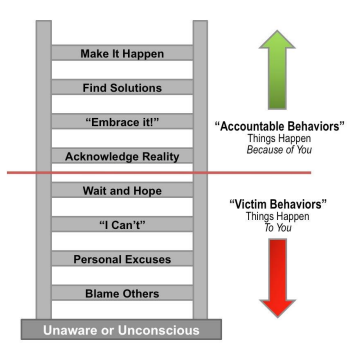
Life’s changes make it very easy for us to fall into a victim mentality. Instead, we need to have an accountable mindset. We need to utilize the accountability ladder to acknowledge reality, own the issue, find a solution, and “get on with it.” A question we should ask ourselves is, “What more can I do to get a different result?” When we’re honest with ourselves, there is ALWAYS something we can do to avoid the insanity of doing the same thing again and again and expecting different results.
3. Use a Uniquely Human Lens
As the Workplace Intelligence article outlined, human qualities such as trust, empathy, relationships, and discernment are not embedded in AI. Neither are diversity, collaboration, assessment, context, inspiration, motivation, desire, and achievement. Pull out your resume and look at it through a filter that highlights these and other uniquely human attributes.Even with your technical accomplishments, you did those utilizing tools and effort. Perhaps your resume could be reworded to highlight or emphasize those human attributes? Perhaps new accomplishments come to mind? How might your STAR stories change?
4. Never Stop Learning
I’m not too adept with technology, and I find that I’m “all thumbs” with it even when I think I’m focused and open-minded about learning. My tech intuition doesn’t exist, and I’m probably about 3 years behind everybody else. BUT, I’m slowly but surely moving forward. Perhaps you need to take some classes to catch on more quickly? Perhaps a tech coach could be useful? Perhaps you should have a standing appointment at the Apple Bar? Whatever it takes, all of us can learn and adapt. See #2 above. 🙂
5. Talk with a Crossroads Guide
Here at Crossroads Career, we have volunteer Guides who have experienced life’s changes throughout their careers. They have willing ears to listen and willing hearts to help. They don’t have a “silver bullet” answer, but they are grounded in God’s Word, and they have a wealth of experiences that may help you with your situation. You don’t have to go through this transition alone, and the more ideas you can glean from qualified people, the better off you’ll be. Click here to request your free 45 minute consultation.
God created each of us as unique human beings. He didn’t command technology to rule the world in Genesis 1. He told Adam and Eve that they would “subdue the earth” (v28) with no mention of any soul-less object that would hold higher regard with Him than them.
Human Connecting Still Matters in the Age of AI
God still loves each of us above anything else in this world. If you are a Christ-follower, He calls us His children…adopted sons and daughters of the King of the Universe. If you are new to seeking faith, God loves you and wants to redeem and restore a relationship with you. Any of our Crossroads Guides would consider it an honor to listen to where you are in life and graciously share with you the Good News of Jesus Christ. Blessings!
Dave Sparkman currently serves as the volunteer Crossroads Career board chair and local ministry leader. He is also the founder and managing director of Spark Your Culture, a corporate culture consulting firm. Prior to that he worked at UnitedHealth Group, a Fortune #5 public company, serving in the role of Chief Culture Officer. His unemployment experience came from the implosion of Arthur Andersen, where he served as the West Region Managing Partner, People.
Connect with a Crossroads Guide
We would love to help you by setting up a time to talk to someone who can provide personalized career assistance.
